


 By
By For nearly five decades, Alex Mukulu stood in the difficult space between art and truth, making theatre that could entertain an audience one moment and leave it questioning itself the next.
On Saturday, August 15, 2026, Mukulu, one of Uganda’s most distinctive playwrights, actors, directors, musicians and cultural thinkers, died at the age of 72 at Kiruddu Hospital after suffering liver complications. His death closes a remarkable chapter in Ugandan theatre, but perhaps not the conversation he spent his life provoking.
Born in 1954 in Misebe, Ssingo County, Buganda, to Paulo Kayizi Lugaizi and Victoria Ndagire, a daughter of Prince Yokana Kimbugwe of Lungujja, Mukulu attended Kololo Secondary School before studying Film and Drama at Makerere University. From there, he would grow into one of the most formidable figures in Uganda’s theatre tradition.
But describing Mukulu simply as a playwright would be too small. For Mukulu, theatre had a responsibility, it was supposed to make people think.
He was a storyteller, actor, director, songwriter, musician, cultural commentator and, perhaps most importantly, an uncomfortable reflection.
Through works such as 30 Years of Bananas, Wounds of Africa, Dances with Poverty, Muzukulu wa Kabangala, Opera Bakisimba, Radio Mambo Bado, Seven Wonders of Uganda and Guest of Honour, Mukulu turned the stage into a place where Uganda could confront its politics, contradictions, history, culture, poverty, power struggles and everyday absurdities.

30 Years of Bananas, first staged in 1991, became particularly emblematic of his approach. Three decades later, when Uganda marked 60 years of independence, Mukulu was still interrogating the same questions of survival, leadership and what independence had actually delivered. “The survival factor is still with us,” he told media.
He could also be deliberately difficult. Those who knew him describe a man who was direct, uncompromising and unwilling to flatter people merely to make them comfortable. Jack Kinobe Sserunkuuma, director of the Link Afrika Cultural Exchange Programme, remembered Mukulu as someone whose honesty could arrive without social cushioning. Yet that bluntness was part of his creative philosophy. He wanted people to question, disagree and think, rather than simply applaud.
Perhaps that is why his work endured. Mukulu understood that theatre was not merely a place for spectacle. It was a place to think.
In 2024, while discussing his production Kulumbisi and Kulunkalu, he described Uganda through the image of two grasshoppers placed in the same container and eating each other. The metaphor was deliberately uncomfortable, a country in which its people could destroy one another politically, socially and spiritually.
He was equally restless about the state of theatre itself. He criticised artists for losing discipline and audiences for becoming too accustomed to entertainment without reflection.
His influence also reached beyond Uganda. In 2007, Journey to Self-Realisation was performed at the opening ceremony of the Commonwealth Heads of Government Meeting in Kampala, placing his work on an international stage. His book 30 Years of Bananas was published by Oxford University Press in 1993, while his plays and music carried Ugandan stories and cultural questions to audiences beyond the country’s borders.
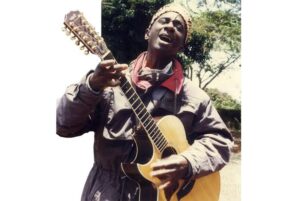
And although he spent much of his career interrogating Uganda, he was also deeply attached to its cultural identity, particularly Buganda. Katikkiro Charles Peter Mayiga, in mourning Mukulu, remembered him as a gifted artist who loved Buganda’s traditions and culture and as a loyal subject of Kabaka Ronald Muwenda Mutebi II. Mayiga praised his work as a writer, director, actor, songwriter and singer, saying generations had learnt from his productions.
Mukulu did not disappear quietly into retirement either. In 2024, he returned to the National Theatre with Kulumbisi and Kulunkalu, an ambitious work that blended Shakespeare’s Romeo and Juliet with Ugandan history, music and contemporary political realities. He explained that he wanted to use a universal story to speak to the world about Uganda’s own conflicts, divisions and longing for reconciliation.
His last notable public appearance came the following year during a National Theatre Jam Session, a fitting reminder that even after decades in the profession, he remained connected to the stage and to the younger generation of artists.
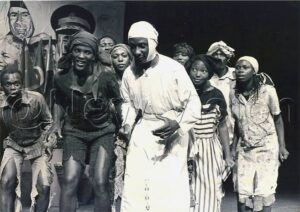
Although Mukulu’s curtain has fallen, the questions he left behind still remain.
What does independence mean to a people still struggling to survive? What happens when power becomes more important than people? What does culture mean when a society begins to forget itself? Can art change the way a country sees itself?
Mukulu spent a lifetime asking questions like these, sometimes through satire, sometimes through music, sometimes through history, and sometimes simply through a character standing under theatre lights and telling a difficult truth.
Uganda will bury Alex Mukulu, but it will not easily bury the questions he staged. For a man who spent his life making Uganda reflect itself, perhaps that is the most fitting final act.