
 By
Compiled by Tezra Kisakye
As Kampala intensifies efforts to rescue vulnerable children and clear its streets, mothers with babies remain on concrete verandahs, begging from passers-by. Their plight raises urgent questions about absent fathers, abandoned women, poverty and a city struggling to protect its most vulnerable residents.
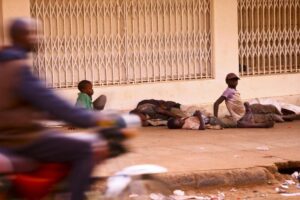
Three minutes into my walk along Fidodido Avenue on Kampala Road, a woman sits on a hard concrete verandah. Two young children cling to her. A girl is strapped to her back, while a boy holds tightly to her arm.
I do not know how long she has been sitting there with her little empty plate, or when she last had a bath. The ashy appearance of her skin is difficult to miss, as are her worn workout clothes. The children look just as unkempt.
She is still there when I return from the mall an hour later, after my dentist appointment.
How long will she remain there before she returns home? And where, exactly, is home?
This is not the first time I have seen her. Nor is it the first time I have seen the woman who sits a short distance away, almost as if the two have an unwritten ownership with the pavement.
The mother with two children occupies a spot near the end of the verandah. She is visible almost immediately after turning the corner by the sports shop at the Indian-owned building.
The other woman also has a baby. She, too, sits with a little plate before her, her appearance not any different from her neighbour’s.
She seems more aware of her surroundings than her neighbour, however, who appears disoriented and occasionally mumbles to herself. Yet both women seem to be living under similarly difficult conditions.
A few steps away sits another woman. Two more occupy the opposite end of the avenue. And each of them with at least one baby.
I wonder what circumstances must have forced these mothers to the streets. What have they endured? And what happens when the last passer-by leaves and the shops close for the day?
But most importantly, where are the fathers of these children?
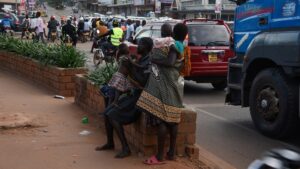
It is difficult to look at a woman begging with a baby in her arms without wondering about the circumstances that brought her there.
If she has no secure shelter, no reliable income and barely enough to feed herself, what circumstances surround the conception and raising of her child? Was there a partner who promised to support her? Did he leave when she became pregnant? Does he know where she and his child spend their days?
And if he knows, why is she sitting on a hard concrete verandah, depending on strangers to survive?
These are not questions about whether poor women deserve to have children. They are questions about the responsibility that comes with fatherhood and the vulnerability of women when they are left to carry the burden alone.
A child does not come into the world through a mother’s efforts alone. Yet in many urban parts of Kampala, it is the woman who is seen carrying the baby and seeking help from strangers.
What does fatherhood mean when a mother is left to beg on the streets with the child she shares with a man who may have walked away?
A woman can lose her home, her income or the support of her family. She can become ill or experience a crisis that leaves her unable to care for herself as she once did. Whatever the circumstances, the presence of a child should prompt questions about who is responsible for that child’s welfare.
And where a father cannot be identified or traced, what other family or social support is available?
The woman with two children appears to be particularly struggling in ways that go beyond the obvious difficulty of begging.
She sometimes mumbles to herself and does not always appear attentive to her surroundings. I cannot determine her mental state from observation, and it would be wrong to diagnose her without an assessment.
Still, watching her raises a concern, who is responsible for her and the children if she cannot adequately care for herself?
Who notices when a mother is unwell? Who checks whether her children have eaten and who ensures that they have somewhere safe to sleep?
KCCA crackdown
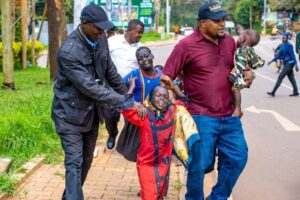
The sight of mothers begging with babies is not new to Kampala. For years, the city has grappled with street-connected children, begging, suspected trafficking and the exploitation of minors.
In June 2022, Kampala Capital City Authority (KCCA) launched the Kampala Capital City Child Protection Ordinance, which prohibits sending children to beg or solicit money in public places. It empowers authorities to rescue children found begging and place them under the care of probation and social welfare officers.
At the launch, former Kampala Lord Mayor Erias Lukwago said: “This law is not about criminalizing street begging. When formulating it we had to strike a balance between humanitarian assistance, generosity and using children to beg.”
Therefore, a child begging on the street may be experiencing poverty or exploitation. A mother begging with a child may be struggling to meet the family’s basic needs. In other cases, adults may be deliberately using children to attract sympathy and collect money.
In April 2025, KCCA announced that it had rescued 157 children and arrested 18 adults suspected of using minors to beg. KCCA spokesperson Daniel NuweAbine said many of the children had been brought from eastern Uganda.
“What we found was deeply concerning,” NuweAbine said, describing the circumstances uncovered during the operation.
The authority said the rescued children were taken for counselling, rehabilitation and reintegration support.
The issue remained prominent in September 2026, when KCCA reported returning 156 rescued children to school in Napak District after rehabilitation at Masulita Children’s Village in Wakiso District.
According to the authority, 213 vulnerable people were returned to Napak. The group included 22 youths placed in vocational skills training, while 20 mothers and 15 babies were retained at Napak Central Police Station pending court proceedings over the alleged use of children for begging.
KCCA Executive Director Sharifah Buzeki warned against recruiting and transporting children to the city for begging.
“Children cannot be recruited, exploited or used as a source of income for another person,” Buzeki said.
The figures demonstrate the scale of the child-protection challenge and the fact that some people found on Kampala’s streets may themselves be victims of exploitation.
However, for the women on Fidodido Avenue and many others on Kampala streets, it remains unclear whether any authority has assessed their circumstances or offered them assistance.
The problem remains
Kampala’s efforts to restore order and protect children from exploitation are important. Pedestrian walkways should be accessible, and children should not be exposed to harmful conditions or used to generate income for adults.
But removing someone from a street corner does not automatically resolve the circumstances that brought them there.
If a mother has no secure accommodation and no reliable family support, where does she go after being moved?
If she is experiencing a serious health crisis, who ensures she receives appropriate care? If she has been abandoned by her partner, who helps her establish whether he can be traced and held accountable for his parental responsibilities? If she is being exploited, who protects her as well as her children?
These questions require more than enforcement. They require individual assessments and coordination between KCCA, police, probation and social welfare officers, health workers, local governments and organisations equipped to assist vulnerable families.
KCCA’s September 2026 operation shows that rehabilitation and reintegration can be part of the response. Children were returned to school, while some young people entered vocational training.
The longer-term question is whether the support offered is sufficient to prevent families from falling back into the same circumstances.
Who helps a mother who has nowhere to go?
For a woman sitting on a pavement with a baby, the immediate need may be food. But her situation may involve much more than hunger.
She may need safe accommodation, healthcare, childcare, protection from violence, family tracing or help establishing a reliable income. If she has been abandoned by her partner, she may need assistance to understand and pursue the support available to her and her children.
KCCA’s child-protection framework provides for probation and social welfare officers to intervene when children are found begging or are otherwise at risk. Its recent rehabilitation operations also show that authorities are working with other organisations to support rescued children.
Yet the existence of a law or rehabilitation programme does not tell us whether a particular woman has received help, whether services are accessible to her or whether she has a safe place to go.
That is why the women on Fidodido Avenue need more than observation. Their circumstances need to be established directly, with their consent and dignity respected.
The public also has a role. Where a child appears to be in danger or an adult appears unable to care for a child safely, the appropriate response is to alert relevant social welfare or child-protection authorities rather than make assumptions about the family.
Kampala has demonstrated that it can rescue children, facilitate their return to school and pursue those suspected of exploiting them. The next challenge is to ensure that vulnerable mothers are not left without help, that children are protected, and that fathers and other responsible adults are not allowed to disappear from the conversation when their children need them.
For now I do not know the fate of the woman on Fidodido Avenue. But I hope that she and her children got a few coins on their empty little plate today.